








































































Tractor Supply Sales Associate Job Description
-
Onstipes / 2 weeks
- December 30, 2025
- 0
- 12 min read

A sales associate role at Tractor Supply Company is often misunderstood as a standard retail job. In reality, it sits at the intersection of customer service, product guidance, and hands on store operations. People searching for this role are usually evaluating whether the work aligns with their skills, physical capacity, schedule flexibility, and long term goals, not just whether it is another retail position.
This job exists to support customers who often have practical, task driven needs. Shoppers may be maintaining livestock, managing land, caring for pets, or handling seasonal outdoor work. That context shapes everything about the role, from how conversations happen on the sales floor to why product familiarity matters more here than in many general retail environments.
From an employer perspective, the position is foundational. Sales associates directly influence customer satisfaction, store efficiency, and repeat business. From a candidate’s perspective, it can be an entry point into retail leadership, a steady hands on role, or a poor fit if expectations are misaligned.
This article breaks the role down clearly and realistically. It focuses on what the job actually involves, what skills matter most, common mistakes applicants make, and how to evaluate whether this position fits your work style before applying.
What Is a Sales Associate at Tractor Supply Company?
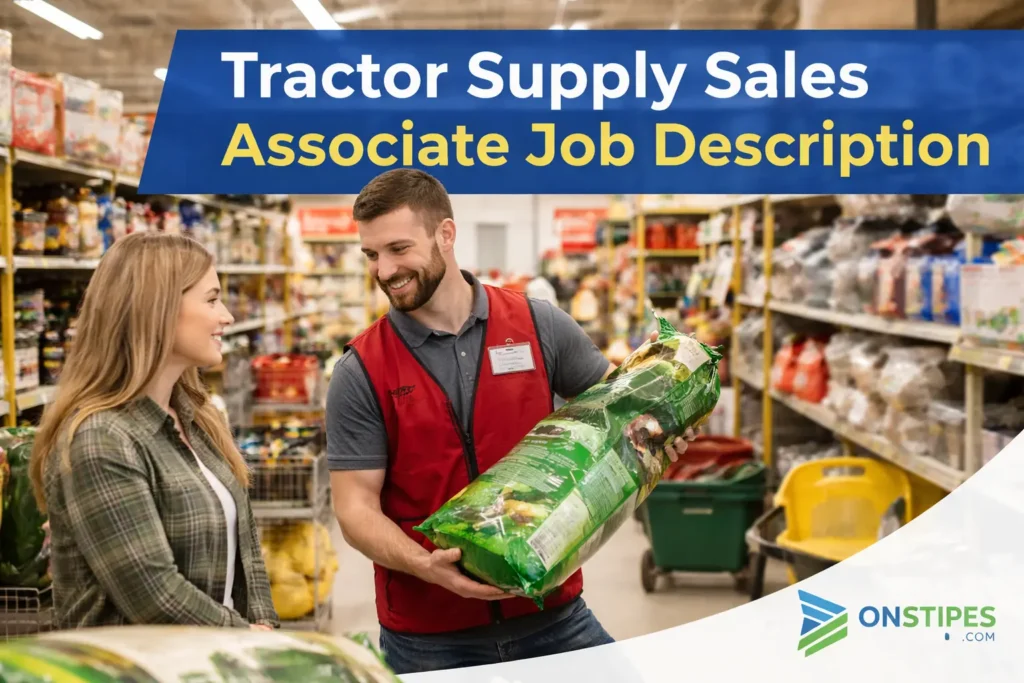
A sales associate at Tractor Supply Company is a frontline retail employee responsible for helping customers find practical solutions while keeping the store operating smoothly. The role combines customer interaction, product guidance, and physical store tasks. It is not limited to ringing up purchases. Associates are expected to assist customers throughout the store and contribute to daily operations.
Unlike many retail roles, this position serves customers with specific, purpose driven needs. Shoppers are often looking for equipment, feed, tools, or supplies they plan to use immediately. That means associates are expected to listen carefully, understand basic use cases, and point customers toward appropriate options rather than simply directing them to an aisle.
The role also supports store standards behind the scenes. Associates help with stocking, organizing merchandise, unloading deliveries, and maintaining safe, clean aisles. These responsibilities are essential to keeping the store functional and compliant, even though customers may not always see that work happening.
Overall, the position functions as both a service role and an operational role. Candidates who assume it is primarily a cashier job often underestimate the physical and practical demands involved, which can lead to early dissatisfaction if expectations are not aligned.
What Does the Role Actually Involve Day to Day?
On a daily basis, a Tractor Supply sales associate balances customer assistance with ongoing store tasks. The primary responsibility is helping customers locate products and understand basic differences between options. Many shoppers arrive with a specific problem to solve, so the associate’s job is often to clarify needs rather than push a sale.
Outside of customer interactions, a large portion of the day is spent on operational work. This includes restocking shelves, rotating inventory, assembling displays, and unloading deliveries. These tasks require consistent movement, attention to safety, and coordination with team members to keep the store organized and accessible.
Register work is part of the role, but it is not the center of it. Associates rotate through checkout as needed, especially during peak hours, while still being expected to maintain awareness of the sales floor. Multitasking is normal, and priorities can shift quickly based on store traffic.
A common mistake candidates make is assuming each shift follows a fixed routine. In reality, the workload changes daily depending on season, staffing, and customer volume, which favors people who adapt easily rather than those who need rigid structure.
How Customer Service Expectations Differ From Typical Retail Jobs
Customer service in this role is more consultative than transactional. Sales associates are expected to engage customers in short, practical conversations that clarify what the customer is trying to accomplish. The goal is to help them make a workable choice, not to upsell unnecessary items or rush them through a purchase.
Many customers already have hands on experience with the products they are buying. Others may be new and need basic guidance. Associates must adjust their approach quickly, avoiding assumptions while still offering useful input. Listening matters as much as speaking, and credibility comes from accuracy rather than enthusiasm.
Service expectations also extend beyond direct interaction. Keeping aisles safe, products accessible, and shelves organized is considered part of serving the customer. A poorly stocked or cluttered floor directly affects the experience, even if no conversation takes place.
A common mistake is treating this like scripted retail service. Customers tend to notice when advice feels generic, which can erode trust faster here than in many other retail settings.
What Product Knowledge Matters Most in This Position?
Product knowledge in this role is practical rather than technical. Sales associates are not expected to be experts in every category, but they must understand common use cases, basic differences, and safety considerations. Knowing which products solve which problems matters more than memorizing specifications.
The most important knowledge areas typically include animal feed, pet supplies, fencing, seasonal equipment, and basic tools. Customers often ask situational questions, such as which item works best for a specific task or environment. Being able to narrow options confidently builds trust and speeds up decisions.
Learning happens on the job. Associates develop knowledge through daily exposure, internal training, and customer conversations. Curiosity and willingness to ask questions are more valuable than arriving with prior expertise.
A common mistake is trying to oversell knowledge too early. Guessing or improvising incorrect information can create safety risks and damage credibility, especially with experienced customers.
What Skills and Traits Lead to Success in This Role?
Success in this role depends more on reliability and awareness than on sales ability. Strong communication skills help, but the most effective associates are those who pay attention, follow procedures, and respond calmly when priorities change. Consistency matters more than charisma.
Physical stamina is an often overlooked requirement. Associates spend much of their shift on their feet, moving merchandise, and handling items of varying weight. Comfort with repetitive physical tasks reduces fatigue and lowers injury risk over time.
Team awareness is equally important. Stores rely on coordination, especially during deliveries or busy periods. Associates who communicate clearly and step in when needed tend to earn trust quickly from both peers and supervisors.
A common mistake is focusing only on customer facing skills. Performance evaluations also consider task completion, safety practices, and reliability, which can outweigh personality in this environment.
What Are the Physical and Scheduling Requirements?
This role has clear physical expectations that are not optional. Sales associates regularly lift, carry, and move merchandise, including feed bags, fencing materials, and seasonal equipment. Standing, walking, bending, and working outdoors at times are normal parts of the job. Comfort with physical effort directly affects long term performance and safety.
Scheduling is another key factor. Stores operate on extended retail hours, which means associates are typically expected to work evenings, weekends, and some holidays. Shifts may vary week to week based on staffing needs, store traffic, and seasonal demand rather than following a fixed routine.
Flexibility is often valued more than availability for a specific shift. Associates who can adjust hours during busy seasons tend to be relied on more consistently. That flexibility can also influence scheduling stability over time.
A common mistake is underestimating how both physical workload and schedule variability compound together, especially for candidates accustomed to sedentary or fixed hour roles.
How Sales Associates Support Store Operations Beyond the Sales Floor
Sales associates contribute to store performance even when they are not directly interacting with customers. A significant part of the role involves maintaining inventory accuracy, restocking shelves, and ensuring products are placed according to store standards. These tasks support smooth operations and reduce friction during busy periods.
Associates also assist with receiving shipments, unloading trucks, and preparing merchandise for display. This work requires attention to detail and adherence to safety procedures, as mistakes can create inventory errors or workplace hazards. Coordination with supervisors and teammates is essential during these tasks.
Operational support includes keeping aisles clear, managing damaged goods, and flagging low stock or misplaced items. These responsibilities directly affect customer experience, even if customers are unaware of who handled them.
A common mistake is viewing non customer tasks as secondary. In practice, operational consistency is a core performance metric and often influences scheduling and advancement decisions.
What Training and Onboarding Typically Look Like
Training for this role is practical and task focused rather than classroom heavy. New sales associates usually start with basic orientation covering safety, store policies, and core expectations. From there, learning happens largely on the floor through observation, guided practice, and gradual responsibility rather than formal instruction alone.
Early onboarding emphasizes safe lifting, customer interaction standards, and basic product categories. Associates are not expected to know everything immediately, but they are expected to ask questions and follow established procedures. Mistakes are tolerated early when paired with attentiveness and willingness to improve.
Over time, training expands to include inventory processes, seasonal transitions, and store specific routines. The pace depends on store volume and individual performance, not a fixed timeline.
A common mistake is assuming training will be comprehensive before real work begins. In reality, learning continues continuously, and self initiative plays a major role in long term competence.
What Career Paths Are Realistic From This Position?
This role can serve different long term purposes depending on performance and intent. For some, it is a stable retail position with predictable responsibilities. For others, it functions as an entry point into store leadership. Advancement is typically based on consistency, reliability, and operational competence rather than tenure alone.
High performing associates may move into team lead or supervisory roles, where responsibilities expand to scheduling support, training newer staff, and overseeing specific store areas. From there, progression into assistant management or store management is possible, though not automatic.
Skill transfer is another factor. Experience gained here, such as inventory control, customer problem solving, and safety compliance, translates well to other retail, warehouse, or operations roles outside the company.
A common mistake is assuming advancement is guaranteed. Growth requires visible accountability, strong attendance, and the ability to manage both people and processes, not just customer interactions.
Common Misconceptions About the Job and Where Candidates Go Wrong
One common misconception is that this role is primarily about selling. In practice, it is more about service, accuracy, and follow through. Associates who focus only on being friendly often struggle if they overlook stocking standards, safety rules, or task completion.
Another misunderstanding is assuming product knowledge must be extensive on day one. While learning is important, guessing or giving confident but incorrect answers creates problems. Experienced customers quickly notice misinformation, and safety related errors can have serious consequences.
Some candidates also underestimate the physical aspect, assuming it is occasional rather than constant. This mismatch leads to burnout or early turnover when daily lifting and movement become routine.
Finally, many overlook scheduling realities. Expecting fixed hours or avoiding weekends often conflicts with store needs, which can limit hours or long term viability in the role.
Who This Job Is a Good Fit For and Who It Is Not
This role is well suited for people who prefer active work over desk based tasks. Individuals who are comfortable moving throughout a store, handling physical tasks, and switching between responsibilities tend to adapt quickly. It also fits those who enjoy practical problem solving and helping customers with clear, real world needs.
The job works best for candidates who value structure but can tolerate variability. Procedures are clear, but daily priorities change based on deliveries, weather, and customer traffic. People who stay calm when plans shift usually perform better over time.
On the other hand, this role is not ideal for those seeking predictable schedules, minimal physical effort, or purely transactional customer interactions. It may also frustrate individuals who dislike repetition or hands on tasks.
A common mistake is applying without honestly evaluating work style. Misalignment here often leads to early dissatisfaction, even when performance is technically adequate.
How to Evaluate This Role Before Applying
Before applying, the most effective evaluation starts with comparing the job’s daily reality to your own work preferences. This role requires sustained physical activity, frequent customer interaction, and comfort with varied tasks. If you prefer predictable routines or low physical demand, the mismatch will show quickly once shifts begin.
It is also important to assess your tolerance for learning on the job. Product familiarity develops over time, but only if you are willing to ask questions, observe experienced coworkers, and accept correction. Candidates who expect structured training before responsibility often struggle in this environment.
Scheduling flexibility should be evaluated honestly. Weekend and holiday availability is not occasional. It is part of normal operations. Limited availability can reduce hours or limit growth opportunities.
A practical step many overlook is visiting a store during peak hours. Observing how associates move, assist customers, and manage workload provides clearer insight than any job posting description.
Conclusion
A Tractor Supply sales associate role is best understood as a hands on, operational retail position rather than a traditional sales job. Success depends on reliability, physical readiness, and the ability to support customers with practical, situation based guidance. Candidates who evaluate the role honestly tend to perform better and stay longer.
The job rewards consistency more than flair. Associates who follow procedures, communicate well with teammates, and handle physical tasks safely are often valued more than those focused only on customer interaction. Product knowledge grows over time, but accuracy and willingness to learn matter from day one.
For the right person, this role can be a stable job or a pathway into retail leadership. For others, mismatched expectations around schedule, workload, or physical demands can make it a poor fit. The key is alignment, not just interest.