






















































Economic Consequences of Translation Errors in Business Negotiations
-
Onstipes / 2 weeks
- December 30, 2025
- 0
- 10 min read

Translation errors in business negotiations are often treated as minor communication issues, but their economic impact is far more significant. In cross-border deals, language is not just a medium. It defines obligations, pricing, risk allocation, and intent. When meaning shifts during translation, even slightly, the financial consequences can extend well beyond a single misunderstanding.
For software and technology buyers operating in global markets, these errors introduce hidden economic risk. Contracts may reflect terms that were never agreed upon, negotiations can stall due to perceived inconsistencies, and trust between parties can erode before a partnership is established. These outcomes are rarely immediate or dramatic, which makes them easy to underestimate during planning and procurement.
The real challenge is that translation-related losses are often indirect. They appear as delayed launches, abandoned negotiations, increased legal review costs, or reduced leverage in future discussions. Because these costs are dispersed across time and departments, organizations frequently fail to connect them back to language accuracy.
This article examines the economic consequences of translation errors in business negotiations from a practical, decision-maker perspective. Rather than focusing on tools or services, it explains where financial damage occurs, why it is difficult to detect early, and how leaders should evaluate translation risk as part of broader negotiation and governance strategy.
How Translation Errors Affect Business Negotiations at an Economic Level
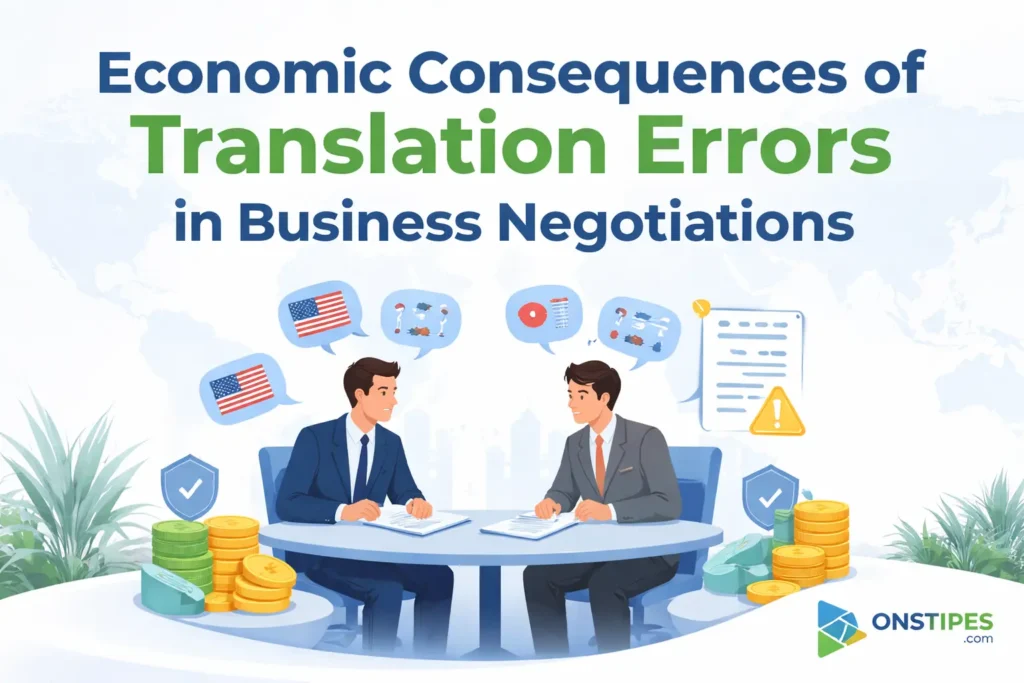
Translation errors affect business negotiations by distorting economic intent. The agreed value, risk, and responsibility embedded in language are easily altered. In negotiations, words define pricing models, delivery obligations, liability limits, and performance metrics. When meaning shifts across languages, the economic balance of a deal changes. One party may assume protections or concessions that the other never intended to grant, creating financial exposure before a contract is even signed.
The economic impact is amplified because negotiations are cumulative. Early misunderstandings influence later concessions, timelines, and trade-offs. A mistranslated clause or ambiguous term can force negotiators to overcompensate, accept unfavorable conditions, or prolong discussions to regain clarity. Each adjustment carries a cost in labor hours, delayed revenue, or weakened bargaining position, even if no single loss is immediately visible.
A common mistake is treating translation as a final-step formality rather than a core negotiation variable. Decision-makers often assume that accuracy issues can be corrected later through legal review. In practice, by the time errors surface, economic commitments have already shaped expectations and strategy. Correcting language at that stage often means renegotiating value, not just fixing wording, which is where the real financial damage begins.
Why Small Language Mistakes Can Lead to Large Financial Losses
Small language mistakes lead to large financial losses because negotiations rely on precision, not approximation. A single mistranslated modifier, unit, or condition can change how value is calculated or risk is assigned. In business negotiations, especially those involving software licensing, service levels, or long-term delivery, these subtle shifts can alter cost structures and revenue expectations without either party immediately realizing it.
Financial damage often occurs when errors create false alignment. Both sides may believe they agree, but they are operating on different interpretations of the same terms. This illusion allows negotiations to proceed smoothly until execution begins. At that point, correcting the mistake usually requires concessions, refunds, penalties, or rework, each carrying direct financial consequences that were not budgeted for during deal evaluation.
A frequent misconception is that financial losses only occur when negotiations collapse. In reality, many losses happen inside completed deals. Organizations absorb them quietly through margin erosion, unplanned legal review, delayed deployment, or customer remediation. Because these costs are spread across departments, they are rarely attributed back to translation quality, allowing the same risk to repeat in future negotiations.
The Direct Cost Impact: Contracts, Pricing, and Deal Terms
Translation errors directly affect costs when they alter contractual language tied to pricing, scope, or performance. In business negotiations, terms such as usage limits, renewal conditions, penalties, and service thresholds carry financial weight. When these are translated inaccurately, organizations may commit to unfavorable pricing models or obligations that were never part of the original negotiation intent.
Pricing disputes are especially common in software and technology agreements. Misinterpreted volume definitions, licensing metrics, or regional pricing clauses can lead to underbilling, over-delivery, or disputes that require retroactive correction. By the time these issues surface, invoices may already be issued or services delivered, turning what seemed like a linguistic error into a measurable revenue or cost gap.
A common mistake is assuming legal review alone will catch these problems. Legal teams review language for enforceability, not for whether the translated terms preserve the negotiated economic balance. If pricing logic or commercial assumptions shift during translation, the contract may still be legally valid while being economically misaligned, locking the business into avoidable financial loss.
Indirect Economic Damage: Delays, Renegotiations, and Missed Opportunities
Indirect economic damage occurs when translation errors disrupt momentum rather than terms. In negotiations, unclear or inconsistent language often forces pauses, clarification cycles, and internal reviews. Each delay increases negotiation costs through extended staff involvement, legal consultations, and opportunity cost as revenue-generating activity is postponed. These delays rarely appear on financial statements but materially affect deal efficiency.
Renegotiations are another hidden cost. When discrepancies emerge after partial agreement, parties must revisit previously settled points. This weakens trust and often shifts leverage. The party perceived as responsible for the error may be pressured to concede on pricing, timelines, or scope simply to keep the deal alive. Economically, this turns a translation issue into a value-transfer problem.
Missed opportunities represent the most underestimated impact. In competitive markets, slow or unstable negotiations can cause buyers or partners to walk away entirely. Deals lost due to communication friction are seldom recorded as translation failures, yet they represent foregone revenue and strategic positioning that cannot be recovered later.
Legal and Compliance Risks Created by Misinterpreted Language
Translation errors create legal and compliance risks when negotiated intent diverges from enforceable language. In cross-border agreements, translated clauses often govern jurisdiction, liability caps, data protection, and termination rights. If meaning shifts during translation, a contract can become legally valid yet economically unbalanced, exposing one party to obligations it never intended to accept.
These risks escalate during disputes. Courts and arbitration panels assess the written agreement, not the negotiation history. When inconsistencies exist across language versions, outcomes may depend on governing-language clauses or local interpretation standards. Proceedings before bodies such as the International Chamber of Commerce can significantly increase costs through legal fees, expert testimony, and prolonged resolution timelines.
A common mistake is assuming bilingual contracts eliminate risk. Multiple language versions often introduce ambiguity unless rigorously aligned and governed. For software and tech buyers, compliance exposure, especially around data handling and service obligations, can trigger penalties or remediation costs. These legal consequences are economic in nature, but they surface late, when correction is most expensive.
How Translation Errors Undermine Trust and Negotiation Power
Translation errors undermine trust by signaling a lack of control over critical details. In business negotiations, especially in technology and software agreements, precision communicates competence. When language inconsistencies appear, counterparts may question whether the organization fully understands its own offering, obligations, or risks. This perception weakens credibility, even if the error itself is unintentional.
Loss of trust directly affects negotiation power. Parties who introduce ambiguity often lose leverage and are forced into a defensive posture, clarifying intent instead of advancing value. Counterparties may slow discussions, demand additional safeguards, or push for more favorable terms to offset perceived risk. Economically, this shifts value away from the party associated with the error.
A common mistake is assuming trust can be rebuilt quickly once language is corrected. In reality, negotiations operate on momentum and confidence. Once doubt enters the process, it influences every subsequent exchange. Research consistently shows that perceived reliability affects deal outcomes as much as price, making translation accuracy a strategic concern rather than a cosmetic one.
Long-Term Opportunity Costs in Global Partnerships
Long-term opportunity costs arise when translation errors quietly weaken relationships that would otherwise generate ongoing value. In global partnerships, negotiations set the tone for future collaboration, renewals, and expansion. When early misunderstandings occur, partners may proceed cautiously, limit scope, or avoid deeper integration, reducing the lifetime value of the relationship even if the initial deal closes.
These costs are difficult to measure because they appear as outcomes that never occur. A partner may choose not to renew, decline joint development, or exclude the firm from future bids. Over time, this limits market access and strategic growth. For software and technology buyers, this can mean slower international scaling or reduced ecosystem participation compared to competitors.
A common mistake is focusing only on immediate deal economics. Organizations often optimize for closing terms while overlooking how language accuracy affects long-term alignment. Sustained cross-border collaboration depends on clarity and mutual confidence, both of which are undermined by repeated communication failures.
Industries Where Translation Errors Carry the Highest Economic Risk
Translation errors carry the highest economic risk in industries where contracts encode complex technical, regulatory, or usage-specific meaning. Software, cloud services, fintech, healthcare technology, and enterprise SaaS agreements rely on precise definitions for access rights, data handling, uptime guarantees, and liability. In these environments, even minor wording errors can change how services are delivered or priced, creating ongoing financial exposure.
Regulated industries amplify this risk. Misinterpreted compliance language can trigger audits, fines, or forced remediation. Errors related to data residency, security standards, or reporting obligations may violate local regulations despite good-faith negotiation. These outcomes impose costs that far exceed the original value of the contract.
A common mistake is assuming risk is evenly distributed across sectors. In reality, industries with recurring revenue models and long-term service commitments suffer compounding losses when translation errors persist. For tech buyers, this makes industry context essential when assessing language risk during negotiations.
Common Assumptions Businesses Get Wrong About Translation Accuracy
One common assumption is that fluency equals accuracy. Negotiation language requires domain expertise, not just linguistic competence. A translator may understand the words but miss the economic or technical implications behind them, especially in software licensing, performance metrics, or pricing logic.
Another mistake is believing that post-negotiation review will catch all issues. By the time contracts reach legal review, commercial assumptions are already embedded. Correcting them often means reopening negotiations, which carries financial and reputational cost. Organizations also underestimate how often internal stakeholders rely on translated summaries rather than original-language documents.
Finally, many businesses assume errors are rare events. In reality, small inaccuracies accumulate across emails, drafts, and revisions. Individually minor, they collectively distort intent, creating economic drift that is difficult to trace back to its source.
How Decision-Makers Should Evaluate Translation Risk Before Negotiations
Decision-makers should evaluate translation risk as a governance issue, not an operational detail. This means identifying where language directly affects pricing, liability, compliance, and delivery before negotiations begin. Mapping these risk points helps teams prioritize accuracy where economic impact is highest rather than treating all content equally.
Evaluation should also consider workflow design. Who relies on translated information to make decisions? How are changes tracked across languages? Without clear accountability, inconsistencies multiply. For software and tech buyers, this is especially critical when negotiations span product, legal, and compliance teams across regions.
A frequent oversight is focusing on speed over control. While fast negotiations are valuable, clarity protects long-term value. Treating translation as part of risk management, rather than a support task, allows organizations to prevent economic loss rather than absorb it later.