

















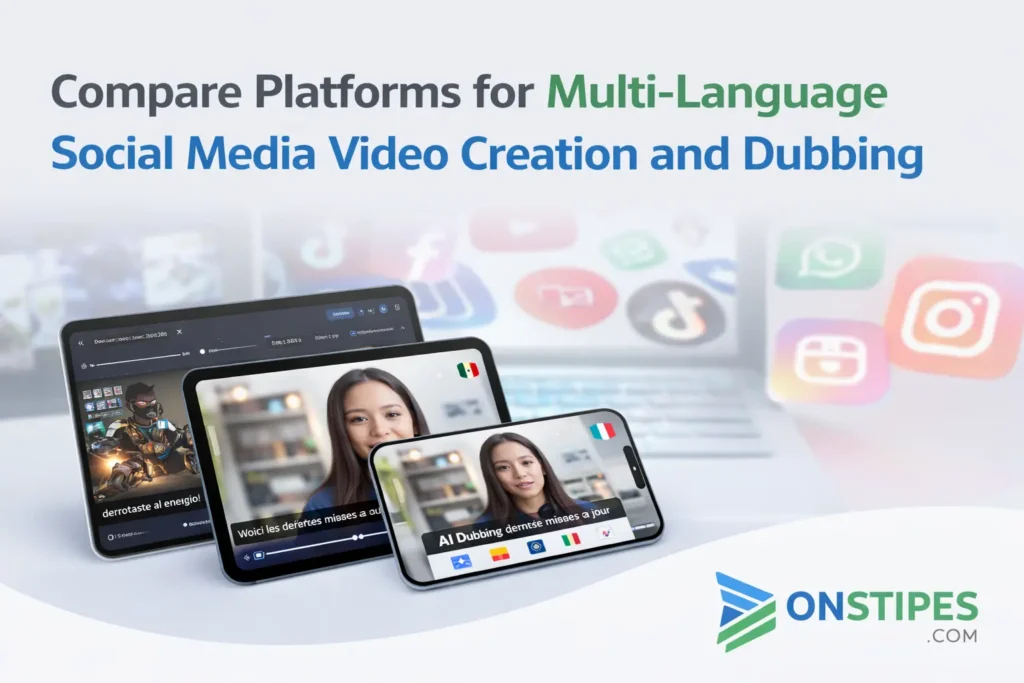





























Compare Platforms for Multi-Language Social Media Video Creation and Dubbing
-
Onstipes / 6 days
- December 30, 2025
- 0
- 11 min read

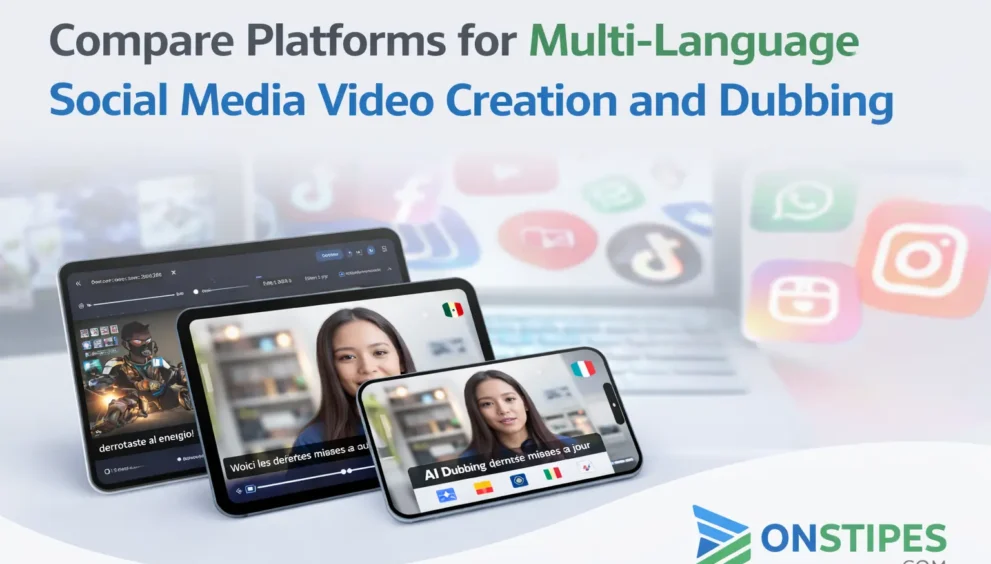
Creating social media videos in multiple languages once meant recording separate versions, hiring voice talent, or relying on subtitles that many viewers ignored. Today, AI-powered video creation and dubbing platforms offer a faster alternative. Creators can translate, dub, and republish the same content for global audiences with far less effort. For gamers and tech creators in particular, this shift opens access to regions where demand already exists but language has been the main barrier.
At the same time, not all platforms solve the same problem in the same way. Some are built for rapid social publishing, while others are designed for enterprise-level localization. Marketing pages often blur these differences, making it difficult to tell which tool truly fits a creator’s workflow. Features such as language count, lip sync, or voice cloning are easy to promote but harder to evaluate in real use.
This article compares multi-language social media video creation and dubbing platforms from a real-world, usage-focused perspective. Instead of promoting tools, it explains how these systems work, where they add value, and where creators commonly encounter limitations. The goal is to help readers make informed decisions based on content type, workflow needs, and long-term scalability rather than hype.
What Problem Are Multi-Language Video Creation and Dubbing Platforms Solving?
These platforms solve a reach problem, not a creativity problem. Most creators can produce engaging videos in one language, but social platforms reward global distribution. Language becomes the bottleneck. Multi-language video creation and dubbing tools remove that barrier by allowing creators to publish the same content across regions without re-recording, re-editing, or rebuilding their workflow.
For gamers and tech creators, the issue is amplified. Gameplay clips, tutorials, and reviews rely heavily on voice clarity and timing. Manual translation or subtitles slow production and disrupt consistency. Dubbing platforms automate translation, voice replacement, and captions so creators can scale output while keeping the original format, pacing, and tone intact.
A common misconception is that these tools exist mainly for large brands or corporate training. In practice, individual creators increasingly use them to test new markets, repurpose viral clips, or localize evergreen content. The real value lies in efficiency. These platforms reduce friction between creation and distribution without forcing creators to change how they already produce content.
How Do These Platforms Actually Work Behind the Scenes?
At a practical level, most platforms follow a similar pipeline. They detect speech, translate the language, generate a new voice, and replace the original audio. The system identifies spoken segments, separates speakers when possible, and converts speech into text. That text is then translated, adjusted for timing, and converted back into audio using synthetic voices or cloned voice models.
What differs is the level of control given to the user. Some tools allow script editing, pronunciation adjustments, and speaker assignment before generating the final dub. Others operate as mostly automated upload-and-export systems. For creators, this distinction matters because small translation or timing errors can noticeably affect viewer trust.
Another key difference is how platforms handle context. Gaming and tech content often includes slang, product names, or on-screen references. Tools that allow glossary control or manual corrections tend to produce more reliable results over time. While the underlying AI may be similar, workflow design and user control ultimately determine whether the output feels usable or frustrating in real-world publishing.
What Makes a Platform Suitable for Social Media?
A platform becomes social-media ready when it supports speed, format flexibility, and repeatability. Translation alone is not enough. Creators need tools that reflect how short-form content is consumed, edited, and published on platforms such as TikTok, YouTube Shorts, and Instagram Reels.
The most practical platforms combine dubbing with basic editing features like clip trimming, caption styling, and aspect ratio presets. This allows creators to localize content without constantly exporting files between different tools. When the dubbing step fits naturally into the editing workflow, overall production time drops significantly.
Pacing is another overlooked factor. Social videos rely on tight timing and natural pauses. Platforms that preserve original timing or allow manual adjustment perform better in real feeds. Tools built mainly for long-form or corporate localization often struggle here, producing dubs that sound technically correct but feel socially awkward.
Which Features Matter Most for Gamers and Tech-Focused Creators?
For gamers and tech creators, the most important features are those that preserve intent and timing. Viewers care less about perfect translation and more about whether the voice matches the pace, energy, and clarity of the original clip. This makes voice quality, timing control, and multi-speaker handling more important than sheer language count.
Consistency is another key requirement. Tech channels often build trust around a recognizable voice and delivery style. Platforms that support voice cloning or stable voice profiles help maintain that identity across languages. Without this, translated content can feel disconnected even if the information itself is accurate.
Creators also benefit from tools that respect existing workflows. Batch processing, reusable presets, and subtitle exports save time when localizing multiple clips. A common mistake is choosing a platform with advanced AI features but weak day-to-day usability, which slows production instead of scaling it.
How Accurate and Natural Is AI Dubbing Across Different Languages?
AI dubbing is generally accurate enough for publishing, but results are not consistent across all languages or content types. Major languages such as Spanish, French, German, and Portuguese tend to sound more natural because models are better trained on them. Accuracy drops more often with niche dialects, rapid speech, or slang-heavy gaming commentary.
Naturalness depends less on the AI itself and more on how the platform handles timing and sentence restructuring. Literal translations often sound robotic because spoken language does not translate word for word. Tools that rephrase sentences to match speech patterns usually sound more human, even when the translation is not technically perfect.
A common mistake is judging quality based on demo clips alone. Short samples hide issues that appear in longer videos, such as drifting tone or awkward pauses. Testing real content across two or three languages is the only reliable way to assess whether a platform’s dubbing feels natural enough for repeated publishing.
Do These Tools Handle Voice Consistency, Tone, and Multiple Speakers Well?
Voice consistency is one of the biggest differentiators between platforms, especially for creators who appear on camera or narrate regularly. Some tools lock a single synthetic voice per language, while others allow voice cloning or persistent voice profiles. The latter approach produces more believable results over time, particularly when viewers hear multiple localized videos from the same creator.
Handling multiple speakers is another practical concern. Gaming clips often include dialogue, reactions, or team communication. Platforms that can detect and assign different voices to separate speakers reduce confusion and improve clarity. When this fails, all dialogue may collapse into one voice, quickly breaking immersion.
Tone control remains imperfect across the industry. Most platforms prioritize intelligibility over emotional accuracy. Creators should expect to review and adjust output, especially for high-energy or sarcastic content. Assuming AI will fully capture tone without oversight is a common and costly mistake.
How Important Is Lip Sync and When Does It Actually Matter?
Lip sync matters primarily for face-to-camera content. When a creator’s mouth is clearly visible and central to the clip, poor lip sync becomes distracting and immediately signals artificial audio. In these cases, platforms with visual alignment or re-rendered facial motion provide a clear quality advantage.
For gaming clips, screen recordings, and voice-over-only content, lip sync is far less important. Viewers focus on gameplay, interface elements, or commentary rather than mouth movement. Adding lip sync in these situations often increases processing time without improving engagement.
A common mistake is treating lip sync as essential for every workflow. It should be evaluated based on content format rather than marketing claims. Creators should prioritize audio clarity and timing first, then consider lip sync only when the visual context truly requires it.
How Easy Is the Editing and Publishing Workflow for Short-Form Content?
Workflow efficiency is where many platforms quietly succeed or fail. For short-form content, creators need fast turnaround, minimal exports, and predictable results. Platforms that combine dubbing with trimming, caption placement, and aspect ratio presets reduce friction and help creators publish consistently without juggling multiple tools.
Ease of use also depends on how errors are handled. The ability to quickly correct a mistranslation, adjust timing, or regenerate a single segment matters more than having dozens of advanced options. When small fixes require restarting the entire process, productivity drops quickly.
Another frequent mistake is overlooking publishing compatibility. Some tools export clean files but lack social-ready settings such as vertical framing, safe margins, or subtitle burn-in. A smooth workflow ends at upload, not export.
What Are the Real Differences Between Creator-Focused and Localization-Focused Tools?
The core difference lies in who the tool is designed to serve daily. Creator-focused platforms prioritize speed, simplicity, and social formats. They assume frequent publishing, short clips, and a need for quick results rather than perfect linguistic control. Editing, captions, and export presets are usually integrated into the same interface.
Localization-focused tools are built for scale and accuracy. They work well for longer videos, multi-language libraries, or brand-controlled content where consistency across regions matters more than turnaround time. These platforms often emphasize language management, speaker mapping, and API access over hands-on editing.
A common mistake is choosing a localization-first platform for social content and then feeling slowed down by its complexity. The right choice depends on whether the primary goal is publishing speed or language precision.
How Do Pricing Models Compare and Where Do Hidden Costs Appear?
Most platforms price by usage rather than features, but the measurement unit varies. Some charge by minutes of processed video, while others use credit systems that bundle translation, voice generation, and exports. For creators, this makes direct comparison difficult without understanding real usage patterns.
Hidden costs often appear during revisions and scaling. Regenerating clips, changing voices, or exporting in multiple languages can consume credits faster than expected. Watermark removal, team access, or commercial rights are sometimes restricted to higher tiers, increasing the true cost per video.
A common mistake is choosing the lowest entry price without modeling actual output. Gamers and tech creators who publish frequently should estimate monthly volume across languages before committing. Predictable pricing often matters more than the cheapest headline plan.
What Common Mistakes Do Buyers Make When Choosing a Dubbing Platform?
The most common mistake is selecting a platform based on feature lists rather than workflow fit. Many tools advertise similar capabilities, but small differences in editing control, regeneration speed, or export options can significantly affect daily use. What looks powerful in a demo can feel restrictive in real publishing.
Another frequent error is overvaluing language count. Supporting over 100 languages sounds impressive, but if a creator only needs three or four, quality and consistency matter far more. Poor voice quality in a key language causes more damage than lacking rarely used options.
Many buyers also underestimate review time. AI dubbing still requires human oversight. Assuming fully automated output leads to rushed publishing and avoidable errors, especially in technical or fast-paced gaming content.
Which Platforms Fit Different Use Cases?
Different use cases benefit from different strengths. Short gaming clips and highlights benefit most from creator-focused platforms that offer fast dubbing, caption styling, and vertical presets. Speed and repeatability matter more here than deep linguistic controls.
Longer reviews and tutorials often require better script editing and timing control. Platforms that allow text-level adjustments before regenerating audio reduce friction when explaining complex mechanics or technical concepts. This helps preserve clarity across languages without re-recording.
For ads and sponsored content, voice consistency and compliance matter most. Tools that support stable voice profiles and clear commercial usage rights reduce risk. The best platform is the one that aligns with how the content attracts attention or generates revenue.
How Should You Evaluate a Platform Before Committing Long Term?
The most reliable way to evaluate a platform is by testing real content rather than samples. Upload an existing clip, translate it into two target languages, and measure how much manual adjustment is needed before publishing. Time spent fixing issues is the real cost, not just credits used.
Creators should also test consistency across multiple videos. A platform that performs well once but inconsistently over time creates additional work. Stability matters more than peak quality, especially for channels publishing weekly or daily.
Finally, consider exit flexibility. Check export formats, subtitle ownership, and whether content can be reused elsewhere. Long-term value comes from tools that support growth without locking creators into rigid systems.